Böttger in Dresden: a walk in the footsteps of the porcelain inventor
European hard-paste porcelain was invented in Dresden, by a man who was not free. Johann Friedrich Böttger worked for Augustus the Strong, who wanted him to make gold. This walk follows his story through the old town, from the Zwinger to the Brühl Terrace. All stops are in the centre and within walking distance.
Who was Böttger, and why was he held?
Böttger was an apothecary's apprentice in Berlin. In October 1701 he is said to have turned silver into gold in the presence of his apothecary Zorn and three other witnesses, and then fled to Wittenberg. In November 1701 he was brought to Dresden in strict secrecy and lodged in the house of the governor Egon von Fürstenberg, in whose cellar there was an alchemical laboratory. In December Augustus wrote to him personally: he took Böttger's request for protection seriously, but Böttger's freedom would stay limited until he revealed the secret of gold.
What do you see in the Zwinger?
The Mathematisch-Physikalischer Salon is one of the four corner pavilions of the Zwinger, built in 1710–1714. Here you can see the burning mirrors of Andreas Gärtner and Ehrenfried Walther von Tschirnhaus. With mirrors and lenses Tschirnhaus reached 1,400 °C without great expense, which mattered for experiments with porcelain.
The Porcelain Collection was founded by Augustus in 1715. The famous "Dragoon Vases" are there: in 1717 Augustus gave the Prussian king Frederick William I 600 horsemen, who were formed into the Wuthenow dragoon regiment, and received in return 151 porcelain vessels from the palaces of Oranienburg and Charlottenburg.
Where did Böttger work in the palace?
In May 1703 Böttger's experiments were moved to the Goldhaus in the Residenzschloss, a laboratory for making gold, where he was given two rooms. Tschirnhaus also had a laboratory there. In 1703 Böttger fled to Austria but was caught and brought back.
Why is the Hofkirche part of this story?
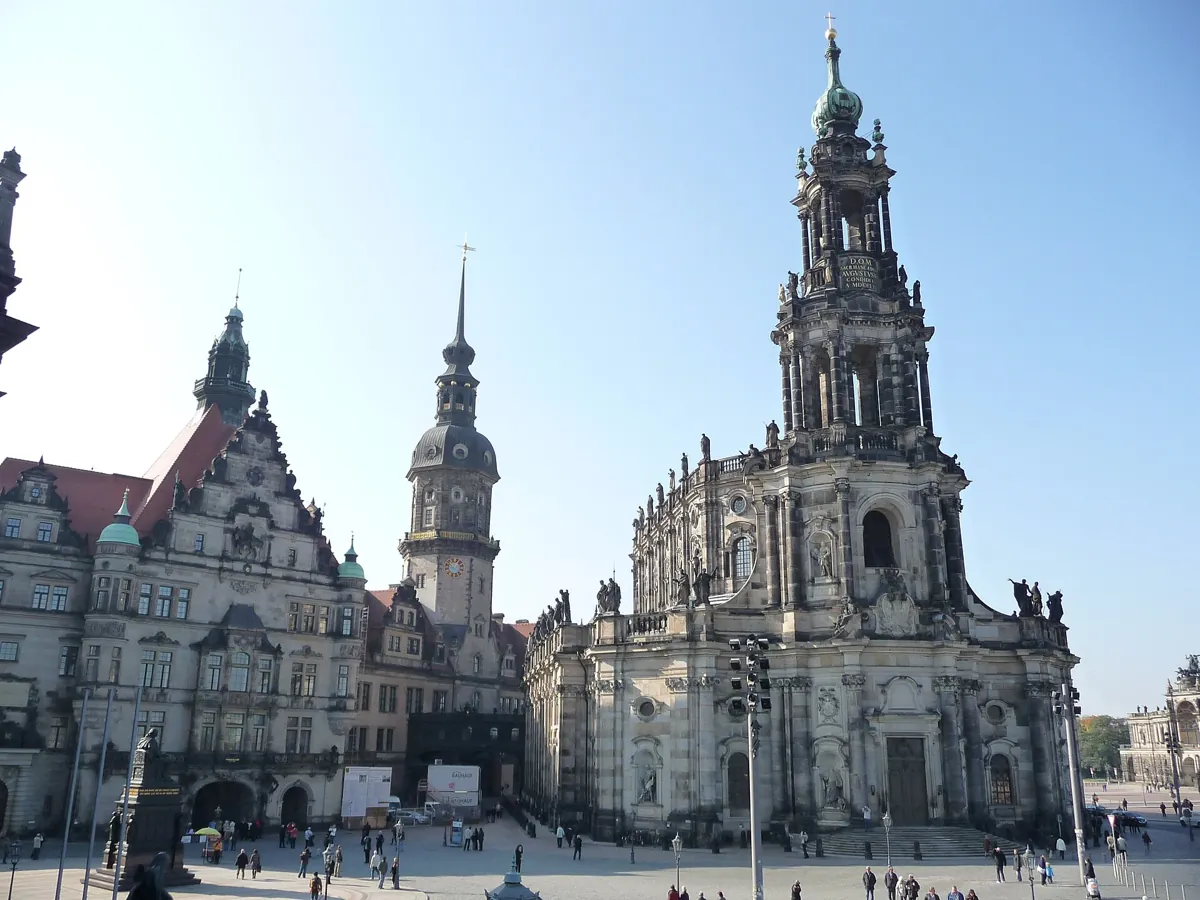
Augustus converted to Catholicism in 1697 to obtain the Polish crown. The Catholic Hofkirche opposite the palace was built in 1739–1755 by Gaetano Chiaveri.
What does the Fürstenzug show?
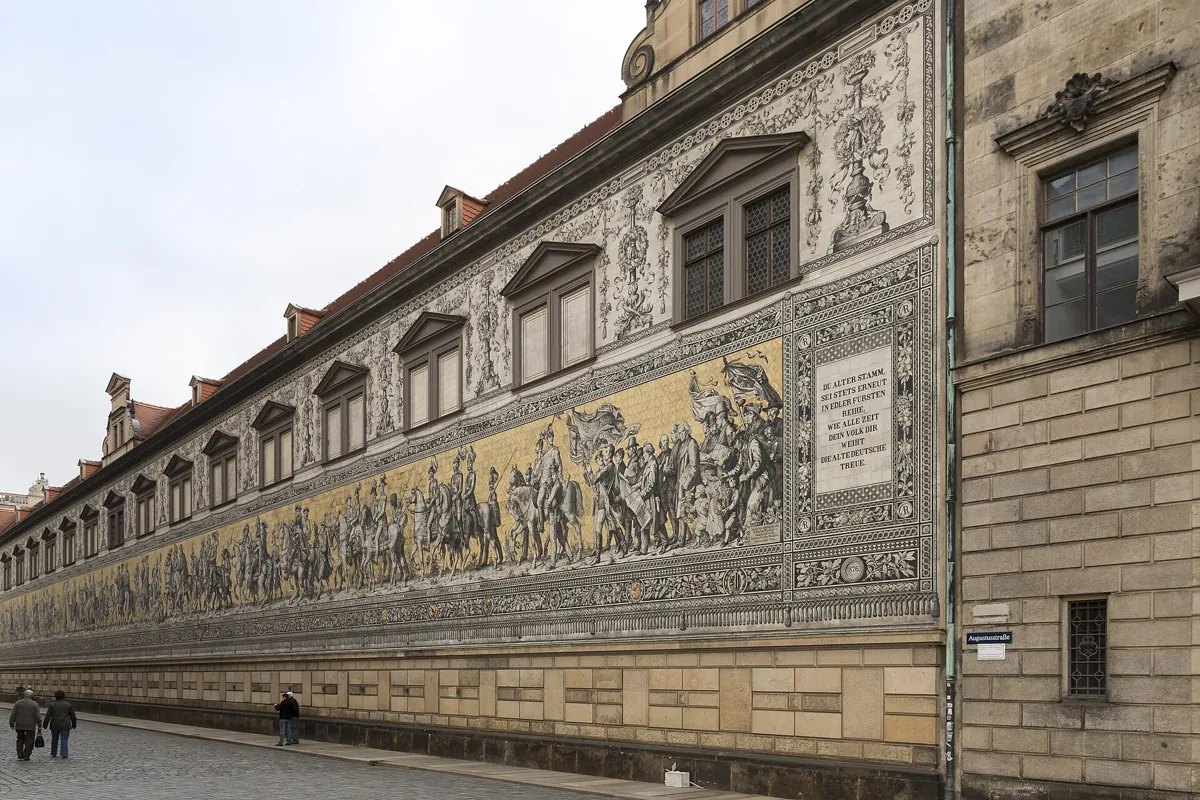
The Fürstenzug ("Procession of Princes") on Augustusstraße consists of about 23,000 tiles of Meissen porcelain, is 102 metres long and is considered the largest porcelain picture in the world. It shows rulers of the House of Wettin, each with a name and years of reign beneath. The tiles come from Meissen.
Where was porcelain made?
The Jungfernbastei was built in 1589–1592 as a bastion of the town fortifications. In the casemates beneath it a laboratory was set up for Tschirnhaus and Böttger, and Böttger lived in a fenced house on the bastion. White European hard-paste porcelain succeeded in 1707; sources differ on the exact month (October/November or the end of December). Tschirnhaus died in Dresden on 11 October 1708, after which Böttger developed the right glaze.
What remains of Böttger?
The Böttger Monument is a 1.90 metre sandstone stele with a medallion of Meissen porcelain, made in 1982 by Peter Makolies. On 19 April 1714 Böttger was granted freedom, but had to swear not to leave the country and to keep the porcelain secret. In November 1716 he had the kilns on the Jungfernbastei torn down, and porcelain production in Dresden ended. He is buried in the Johanniskirchhof, his grave has not survived, and he never received a noble title.
More stories along the route through Saxony: Görlitz and Zgorzelec: one city, two countries.